Wellness in a space is not created through standout moments.
It is built through consistency — through how a space supports people quietly, throughout the day, without asking anything of them in return.
In this project, the focus was not on adding greenery as a visual layer. It was on integrating planters as part of how the space functions, feels, and performs over time.
A System, Not an Accent
Most people think of plants in an interior as decoration. Something placed to add life, color, or a touch of nature to an otherwise finished space.
This project took a different position.
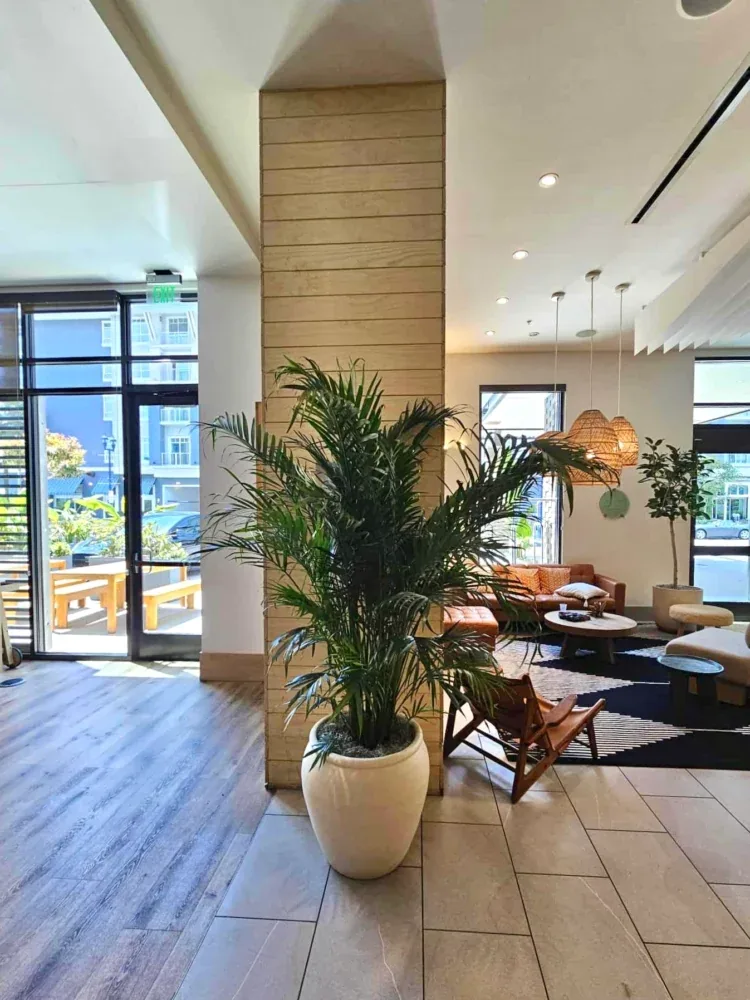
Each planter was positioned to serve a specific purpose within the environment — to anchor transitional areas, to soften structural edges, to create visual continuity between zones, and to extend the experience from interior to exterior.
When greenery is treated as a system rather than an accent, it is not noticed once and forgotten. It is experienced repeatedly, shaping how the space feels at every point of the day.
This is the foundation of biophilic design — and it changes what integration actually means in practice.
Interior: Grounded, Consistent, and Easy to Navigate
Within the interior space, planters were used to reinforce both spatial clarity and emotional steadiness.
Positioned near architectural elements — columns, circulation paths, transitional thresholds — the installations break up visual rigidity without introducing clutter. They guide movement naturally, without requiring signage. They create a subtle sense of rhythm as people move through the space.
The result is an environment that feels structured, but not rigid. Refined, but not overwhelming.
This is the kind of quiet support that most people feel without being able to name. The space simply feels right — easier to be in, easier to navigate, easier to settle into.
For a deeper look at how interior environments shape physical and cognitive experience, our piece on how workplaces either drain or sustain physical well-being is worth reading alongside this one.
Exterior: Extending Wellness Beyond the Interior
The outdoor installations were designed around the same principles.
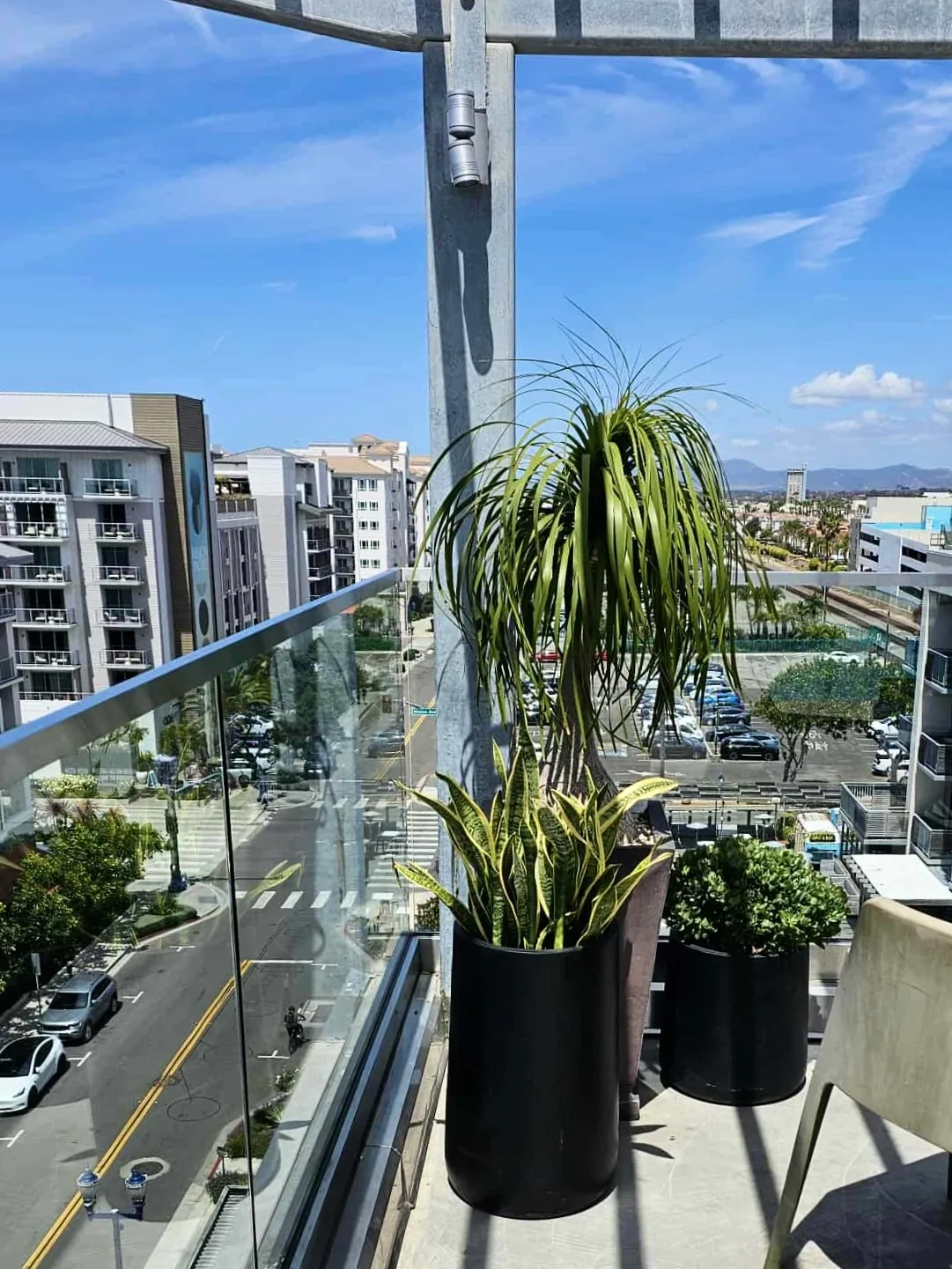
On the balcony, planters were selected and placed to frame views without obstructing them, to introduce vertical variation against a horizontal cityscape, and to create a sense of enclosure without confinement.
The effect is a transformation. What might otherwise function as a pass-through space becomes a functional extension of the environment — a place that genuinely supports pause, reset, and perspective.
Outdoor areas are often underdesigned in workplace and commercial settings. When they are resolved with the same intention as interior spaces, they add a dimension of well-being that is difficult to replicate through interior design alone.
Our approach to exterior and transitional space design explores how these moments can be made to work harder for the people who use them.
Material and Form: Supporting Sensory Balance
Planter selection in this project was deliberate.
Neutral tones, clean silhouettes, and durable finishes were chosen to integrate seamlessly with surrounding materials, to maintain visual calm across different lighting conditions, and to age well over time without disrupting the space.
The goal was not contrast for attention. It was cohesion for consistency.
This distinction matters more than it might seem. Spaces that rely on contrast to feel interesting tend to become visually tiring. Spaces designed for cohesion sustain their quality over time — they remain comfortable to be in long after the initial impression has faded.
This principle applies equally to furniture selection, spatial layout, and every other element that makes up a resolved environment. Explore how ergonomic and material choices contribute to the same outcome.
Designing for Use, Not Just Appearance
What defines this project is not how it photographs. It is how it performs daily.
The installations maintain visual balance from morning to evening. They support both movement and stillness. They require minimal cognitive effort to process — which means the people in the space can direct their attention toward their work and their interactions rather than toward navigating or adjusting to the environment.
People do not need to adapt to the space. The space is designed to support them as they move through it.
This is a meaningful reversal of how environments are often evaluated — by their first impression rather than their sustained performance.
Wellness as a Spatial Outcome
Wellness is frequently treated as an added layer — something introduced into a space once the fundamentals are resolved.
In reality, it is the result of how well a space is resolved in the first place.
In this project, planter integration contributes to reduced visual tension, more intuitive navigation, and a consistent sense of calm across both interior and exterior environments. These are not immediate impressions. They are conditions that hold over time.
A well-designed space does not rely on standout features to feel complete. It works quietly, consistently, and intuitively — and when greenery is integrated with that level of intention, it becomes part of that system.
Not something added to the space.
Something the space depends on.
Interested in how intentional planter and greenery integration can work within your environment? Explore our approach at Biozenic or get in touch to discuss your space.